3 hr
Verona E-Bike Tour with Hilltop Views
Pedal through Roman gates, riverside paths, and hidden quarters before climbing to Castel San Pietro's sweeping panorama.
Reserve
Hand-picked by our editors — only the best 5 experiences from 12 reviewed.
Verified partners for every tour, free cancellation where available, and instant confirmation on every booking.
3 hr
Pedal through Roman gates, riverside paths, and hidden quarters before climbing to Castel San Pietro's sweeping panorama.
Reserve
3 hr
Pedal through Roman ruins, bustling piazzas, and panoramic viewpoints with a local guide
Reserve
7 hr
Pedal through vineyards and olive groves on an electric bike, then savor four regional wines at a local winery.
ReservePrices from verified partners. Availability updates in real time at checkout. Free cancellation policies apply where shown.
The landmarks, rooms, and views travelers on this tour remember — all visible on a single visit.
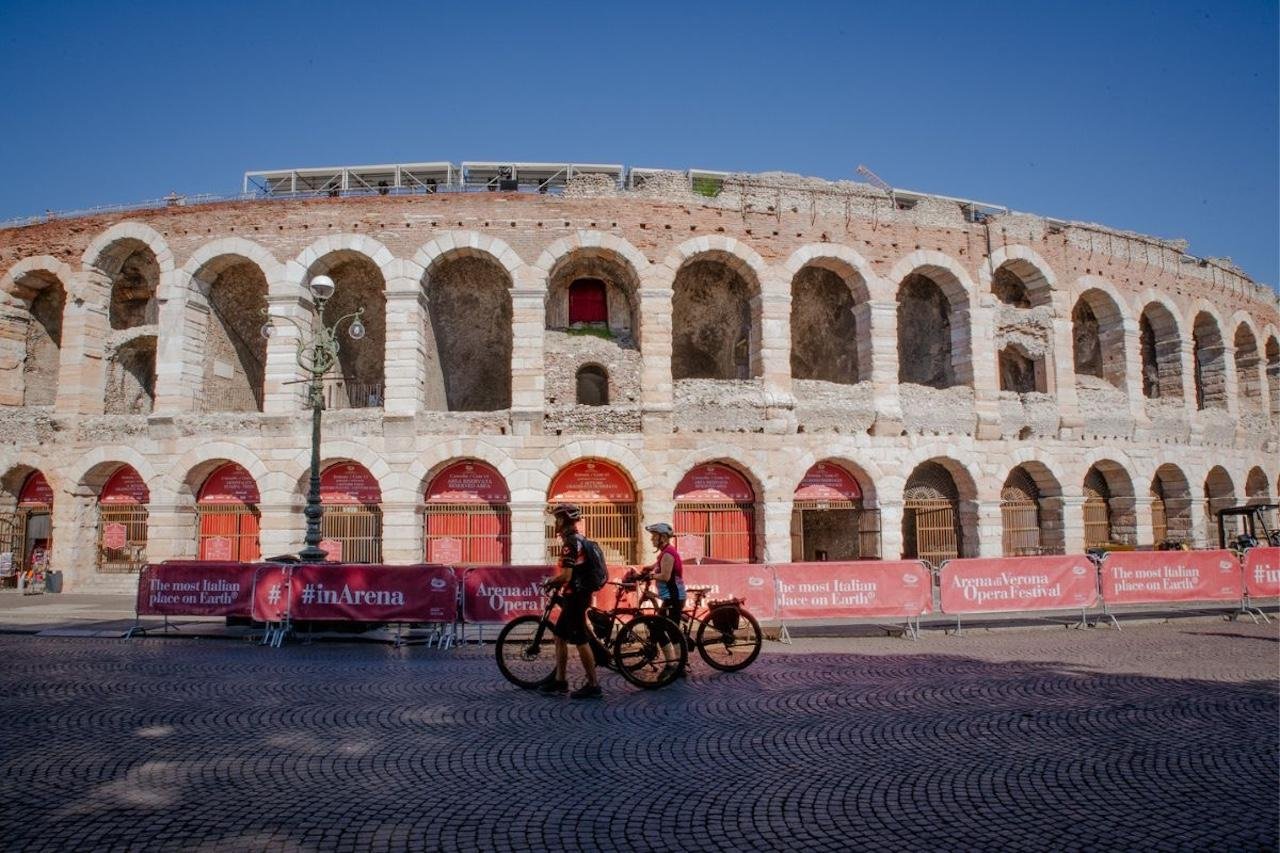
This 1st-century Roman amphitheater is one of the best-preserved in Italy and a central landmark. It remains a world-renowned venue for opera performances during the summer.
They complement each other; most visitors who do both find the organized verona italy bike tour tours more immersive for history, while the municipal system provides superior freedom for independent exploration. Whether you seek curated verona italy bike tour tickets or the spontaneity of local transit, both options offer unique ways to navigate the Adige River banks.
| Feature | Top pick Guided Tour | Bike Verona Share |
|---|---|---|
Structure |
Pre-planned route and guide | User-determined path |
Flexibility |
Fixed schedule and itinerary | Available 06:00–23:59 daily |
Cost |
Varies by provider | 0 EUR entry plus usage fees |
Information Access |
Expert narration and storytelling | Self-directed via signage and maps |
Effort Level |
Moderate cycling pace | Adjustable to personal preference |
Equipment |
Standardized touring cycles | City bike share fleet |
| See tickets → |
Verdict: Choose a guided verona italy bike tour tour for deep context on city landmarks, or opt for the bike share system if you prioritize complete autonomy over your travel pace.
Choose your ticket, select your date, and reserve in under two minutes. Secure checkout handled by our verified partner.
Instant confirmation by email, with a mobile voucher you can save offline. No printing, no queuing at a collection desk.
Arrive at the entrance, show your voucher on your phone, and walk in. Most tickets include priority or skip-the-line access.
Practical details for your visit straight from our verified partners — hours, access, rules, and how to get there.
Casual, athletic attire is recommended for a comfortable verona italy bike tour. Ensure clothing does not interfere with the bicycle chain or pedal mechanisms.
Bicycles are equipped with a front basket and a chain/padlock for securing the bike to fixed supports during short stops. Always keep the key with you and ensure the bike is locked to a stationary object.
Photography is encouraged during your verona italy bike tour, but riders must stop at safe locations to capture images. Avoid taking photos while in motion on cobblestone streets.
The city bike share system is accessible to anyone aged 14 and older; those 14–18 require parental permission. E-bikes with child seats are available for users over 18, with a 20 kg weight limit for children.
Families can utilize e-bikes equipped with child seats for transporting children under 20 kg. Helmets are mandatory when using child seats.
There are numerous cafes and markets along typical verona italy bike tour routes where you can stop for refreshments. Ensure bikes are parked securely at a station or with the provided lock while dining.
Best time to go, insider tips, nearby landmarks, and the cancellation fine print — flip through to skim what matters to you.
Flexible, no hidden fees.
Users may manage or deactivate automatic renewals for annual subscriptions via their user profile. No specific refund policy applies to usage-based fees as the service operates on a pay-per-trip or subscription basis.
Verona's bicycle-sharing network launched in 2008 with just forty stations; by 2026 the city operates more than ninety docking points dispersed from Castelvecchio to the Sant'Ambrogio hillside, threading a web of dedicated lanes through medieval walls and along the Adige's embankments. The Roman grid that anchored the city two millennia ago now guides modern cycle paths, their asphalt tracing the same east-west axis that legionnaires walked between the Arena and Ponte Pietra. UNESCO inscribed the historic center in 2000, citing the continuity of urban form across twenty-three centuries, and that layered chronology rewards slow travel—each piazza holds a Gothic bell tower rising from a Roman forum, each riverside promenade doubles as an archaeological corridor. The terrain favors two-wheeled exploration. Verona sits at 59 meters above sea level on the valley floor, with the first vineyard ridges of Valpolicella climbing to 300 meters just eight kilometers north; e-bike routes bridge that gradient in under an hour, connecting Juliet's balcony to Amarone cellars without the fatigue of a sustained climb. The city's compact Renaissance core measures roughly 1.8 kilometers north to south, small enough that a guided Verona Italy bike tour covers Piazza delle Erbe, the Scaliger Tombs, and San Zeno Maggiore's bronze doors in a single morning loop. Beyond the walls, the Adige River path stretches thirty-five kilometers downstream to Zevio, paved and car-free, passing poplar groves and gravel bars where herons fish at dawn. Cyclists navigate the same stone bridges that connected the Roman municipium to its northern garrison—Ponte Pietra's five arches, rebuilt after 1945 bombing, still rest on first-century piers. The Arena's outer ellipse, 139 meters along its major axis, anchors the southern edge of the historic quarter; bike lanes skirt its limestone façade before turning north through Via Mazzini's pedestrian corridor, where riders dismount and walk beside shopfronts installed in fifteenth-century loggias. Juliet's courtyard lies two blocks east, perpetually crowded, but the parallel route along Via Cappello offers a quieter passage to the Piazza dei Signori, where the Lamberti Tower rises 84 meters and marks the geographic heart of guided cycling itineraries. Valpolicella's viticultural landscape, recognized as a cultural heritage zone in 2016, begins where Verona's suburban sprawl ends. E-bike tours climb through Negrar and Marano valleys, passing stone terraces planted with Corvina and Rondinella vines, the grape varieties that ferment into Amarone. Winery visits punctuate the ascent—century-old cellars dug into hillsides, their temperature stable at 12°C year-round, where tastings pair dried-grape wines with local cheeses. The return descent offers unobstructed views across the Po plain, the Adige tracing a silver arc through the valley floor, the Alps visible on clear mornings as a serrated northern horizon.
"The Roman grid that anchored the city two millennia ago now guides modern cycle paths, their asphalt tracing the same east-west axis that legionnaires walked between the Arena and Ponte Pietra."
A step-by-step walkthrough of the visit — what you'll see, how long each stage takes, and the details that matter.
You collect your bike at Castelvecchio's riverside dock, adjusting the saddle while swallows dart beneath the fortified bridge. The cycle lane follows the Adige north, its surface smooth asphalt separated from car traffic by a painted buffer; you pass joggers and dog-walkers, the current sliding brown and quick to your left. At Ponte Pietra you dismount, walking your bike across Roman stones polished by two thousand years of foot traffic, then remount on the far bank and climb the switchback to San Pietro hill. The gradient steepens—your guide pauses twice for the group to regroup—but the summit reveals the entire city laid out below: terracotta roofs, the Arena's pale oval, the twin spires of Sant'Anastasia framing Piazza delle Erbe. Descending back into the centro storico, you weave through narrow vicoli where balconies overhang the pavement, their geraniums close enough to brush with an outstretched hand. The route threads behind the Arena, skirts the Scaliger Tombs—Gothic iron tracery rising above the street—and enters Piazza dei Signori through an arched sottoportico. You stop for espresso at a corner bar, your bike leaned against medieval brickwork, then roll north toward San Zeno. The basilica's façade appears suddenly, its rose window a stone mandala, bronze doors depicting Old Testament scenes in forty-eight panels. Your guide allows fifteen minutes inside; the Mantegna altarpiece glows in the dim sanctuary, gold leaf catching afternoon light through clerestory windows.
The city bike share system is available daily from 06:00–23:59.
Yes, families can use the service provided children are under 20kg, and the rider is over 18 to use the child seat.
You must use a credit card via the app or website; debit cards and PayPal are not accepted.
Helmets are mandatory if using the e-bike with child seat, and recommended for all riders.
Bicycles feature a basket, but no dedicated storage lockers are provided, so keep luggage minimal.
Yes, most routes, especially the riverside paths, are flat and ideal for casual cycling.
Early morning between 06:00–10:00 offers cooler temperatures and fewer city crowds.
Return the bike to any designated station until the lock light turns green and the bike is secure.
Many operators offer guided verona italy bike tour tours to help navigate historical highlights.